
Islamabad: Pakistan’s exports to Western and Northern Europe slowed in 9MFY despite GSP+, raising concerns over weak global demand.
This trend is unfolding alongside a turbulent global trade landscape. Rising tensions linked to the US-Iran conflict have disrupted regional stability in the Middle East, affecting international shipping routes and contributing to a decline in exports heading toward European markets.

Compounding the issue, the European Union has recently extended preferential trade access to India, a direct competitor to Pakistan, particularly in the textile sector. This move has intensified competitive pressure on Pakistani exporters.
Earlier in the month, the European Union’s Ambassador to Pakistan, Raimundas Karoblis, cautioned that Pakistan’s continued access to the GSP+ scheme is not automatic. He emphasized that future eligibility will depend on the country’s progress in meeting human rights commitments, indicating a stricter stance from EU authorities.
For exporters in Pakistan, the situation presents a twofold challenge: staying compliant with EU requirements while simultaneously competing against countries that are gaining improved access to European markets.
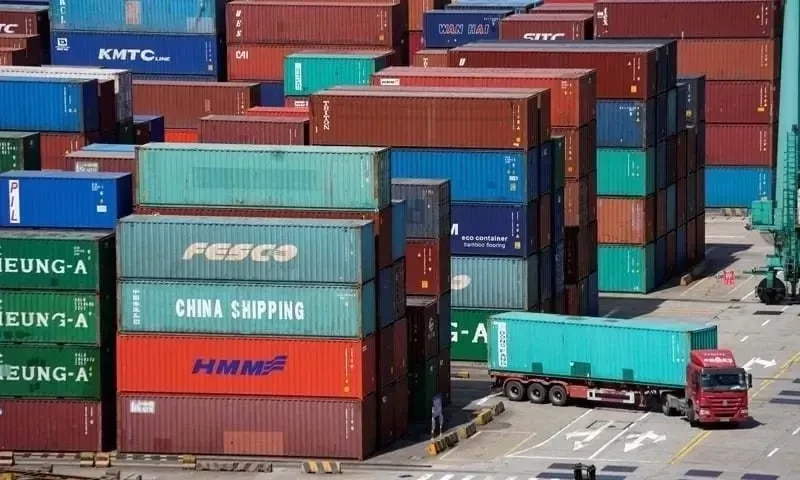
Adding to the pressure, logistical disruptions caused by ongoing geopolitical tensions and increasing domestic production costs are further complicating export operations.
Trade experts warn that the ripple effects of global conflicts could further weaken demand. Rising energy prices in Europe are expected to strain consumer spending, which is already under pressure due to the economic consequences of the Ukraine war. Reduced purchasing power in these markets could lead to lower demand for imported goods, including those from Pakistan.
According to figures released by the State Bank of Pakistan, exports to European countries rose only slightly by 0.94 percent, reaching $6.86 billion during July to March of FY2025-26, compared to $6.79 billion in the same period last year.
The primary drag on growth has been declining exports to Northern and Western European regions.
During FY2024-25, exports to the European Union had increased by 7.44 percent to $8.86 billion, up from $8.24 billion in the previous year. However, in FY2023-24, exports had already experienced a decline of 3.12 percent, despite Pakistan maintaining its GSP+ benefits.
Northern and Western Europe
Exports to Northern Europe recorded a slight drop of 0.85 percent, totaling $557.31 million during the first nine months of FY2025-26, compared to $562.13 million in the same period last year.
Western Europe, which includes major markets such as Germany, the Netherlands, France, and Belgium, continues to account for the largest share of Pakistan’s exports to the EU. However, shipments to this region decreased by 3.14 percent, falling to $3.30 billion from $3.41 billion in the previous fiscal year.
- Germany saw exports decline by 2.97 percent to $1.24 billion
- The Netherlands recorded a 1.78 percent drop to $1.1 billion
- France experienced a 2.62 percent decrease to $411.89 million
- Belgium registered a sharper fall of 4.73 percent to $402.86 million
Southern and Eastern Europe
In contrast, exports to Southern and Eastern Europe showed moderate growth.
Shipments to Southern Europe increased by 6.47 percent, reaching $2.43 billion compared to $2.28 billion in the same period last year. Meanwhile, exports to Eastern Europe rose by 5.06 percent to $566.92 million, up from $539.63 million.
- Spain recorded a strong increase of 7.44 percent, reaching $1.18 billion
- Italy saw exports grow by 4.26 percent to $880.13 million
- Greece, however, experienced a decline of 8.44 percent, with exports falling to $98.16 million
United Kingdom
Following Brexit, the United Kingdom has remained an important destination for Pakistani exports. However, exports to the UK saw a marginal dip of 0.23 percent, standing at $1.62 billion during the first nine months of FY2025-26, compared to the same level last year.
In FY2024-25, exports to the UK had grown by 7.19 percent, reaching $2.16 billion, up from $2.02 billion in the preceding fiscal year.